Achyut BharadwajSeptember 2026
3D Surface Reconstruction using Geodesic Energy Minimization
#
Read the full writeup (PDF) here.
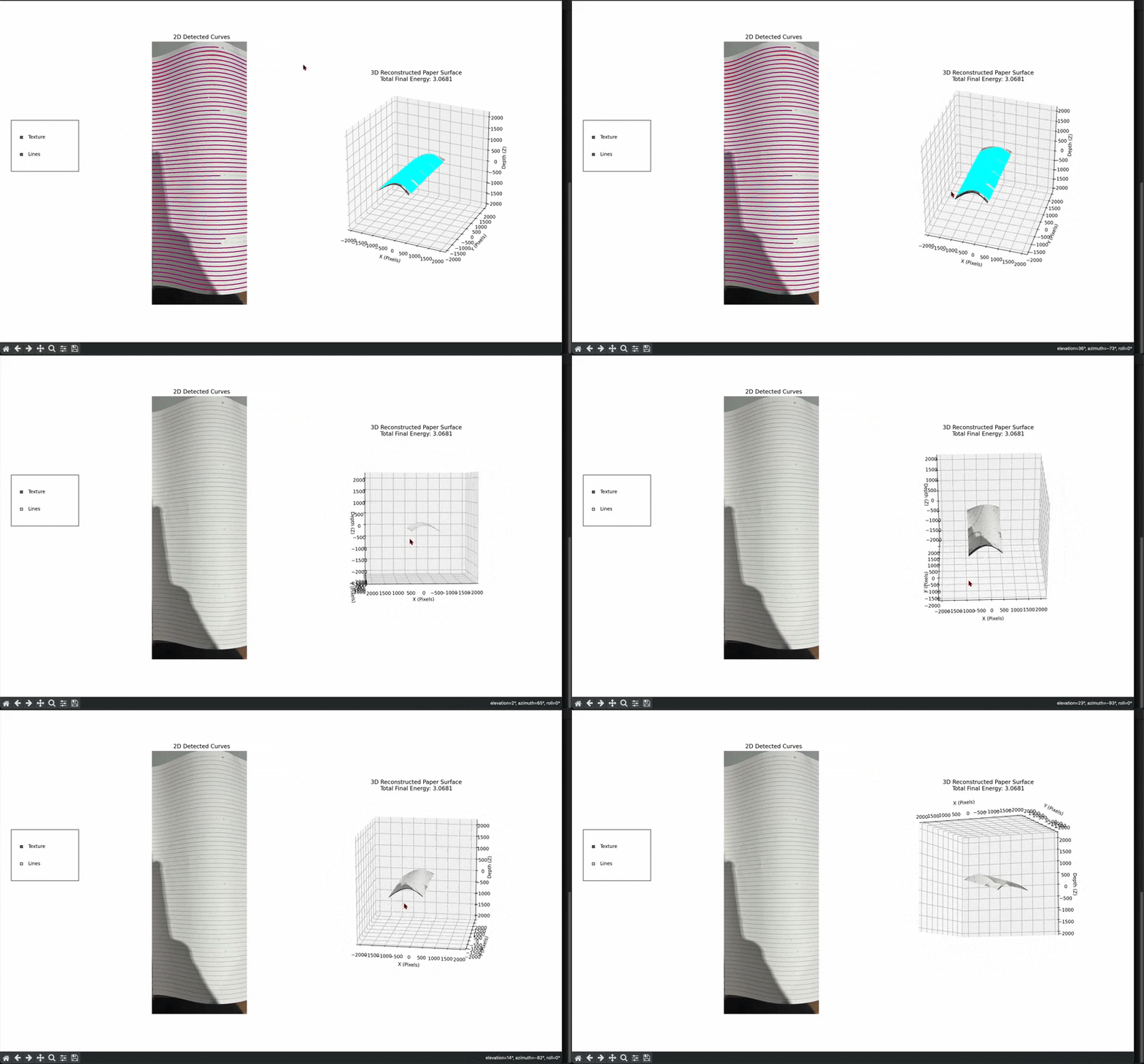
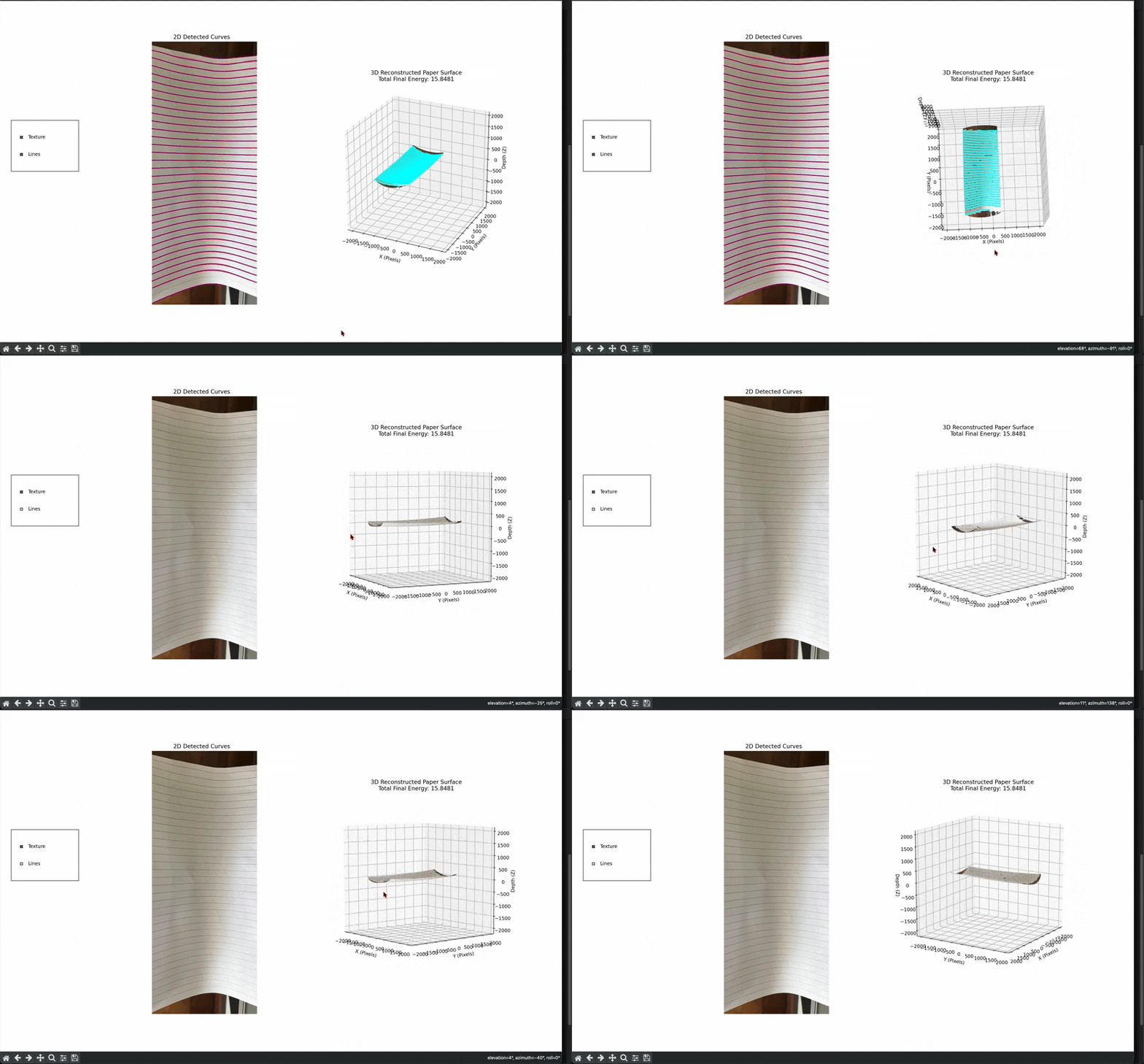
Some Results
#
The Core Algorithm
#
This projects uses a single photograph to reconstruct the 3D embedding of a surface with known geodesics (e.g., a ruled piece of paper which is deformed). The algorithm follows an energy minimization process on the net geodesic energy.
On the highest level, the algorithm begins by guessing that the original surface is simply flat. If the guess turns out inaccurate, the guess is deformed in certain ways to attempt to match the true surface.
...Achyut BharadwajAugust 2026
Expository paper on “The Yamabe Problem in Aubin’s Case” (UChicago Math REU-2026).
Achyut BharadwajAugust 2025
Expository paper on Local Class Field Theory (UChicago Math REU-2025).
Achyut BharadwajAugust 2025
A presentation on Group Cohomology and Cochain Complexes, with applications to Class Field Theory. Talk given at UChicago Math REU-2025.
Achyut BharadwajDecember 2023
This is a short story that I initially wrote for my UChicago supplemental essay for the following prompt:
“If there’s a limited amount of matter in the universe, how can Olive Garden (along with other restaurants and their concepts of food infinity) offer truly unlimited soup, salad, and breadsticks? Explain this using any method of analysis you wish—physics, biology, economics, history, theology… the options, as you can tell, are endless.” – Inspired by Yoonseo Lee, Class of 2023.
...Achyut Bharadwaj, Lex Harie Pisco, Krittika Garg, Swayam Chaulagain,
Counsellor: Sanskar Agrawal,
Mentor: Nischay ReddyJune 2023
Introduction
#
In this paper, we explore the $p$-adic system, by defining it in
multiple ways: as an extension of the $p$-adic integers, as well as an
extension of the rationals. We then proceed to perform analysis in the
$p$-adics, by defining convergence, continuity and discs. We then
describe exponentiation and logarithmic functions over the $p$-adics
as functions derived from power series. We explore the radius of
convergence and other properties of these functions. We then explore
the Artin-Hasse exponential, which, though seemingly random, turns out
to be an integral power series.
...Achyut BharadwajApril 2023
Introduction–The Shuffling Problem
#
Card shuffling is an important part of playing any card game. When a
card deck isn’t shuffled properly, it leads to uneven and unfair
distribution of cards. It would certainly help if you knew what cards
other players had!
Suppose we have a specified shuffling algorithm. Is
it possible for us to guess the outcome of the card shuffling? Is it
possible that the card deck will at some point return to its original
configuration? In a previous article
we explored ways of trying to guess the outcome of a specific type of card
shuffling, known as the riffle shuffle. In this article, we modify the shuffling
algorithm to introduce a flip that introduces some interesting complexities.
...Achyut BharadwajMarch 2023
The Problem
#
Take a square piece of paper. Take a toothpick of a given length. At intervals equal to the length of the toothpick, draw lines on the piece of paper. Now, randomly toss a bunch of such toothpicks so that they fall over the paper. What fraction of the toothpicks will fall in a way so that they intersect one of the lines
drawn? In other words, what is the probability of a single toothpick falling over a line?
...Achyut BharadwajSeptember 2022
Introduction
#
Consider a prime $p$. For what integers $n$ does $p$ divide all of
$$\binom{n}{1}, \binom n 2, \binom n 3, \dots, \binom{n}{n-1}?$$ Can we
characterize all such $n$ given a value of $p$? It turns out that this
happens if and only if $n$ is a perfect power of $p$. How do we prove
this? In fact, there exists a simple proof using elementary methods. But
as always, it is both fun as well as good to prove everything twice. In
this article I present an interesting way to characterize all such $n$
using concepts of finite fields.
...Achyut BharadwajSeptember 2022
Introduction
#
A well known theorem about finite fields states the following.
$F$ is a finite field if and only if
$|F| = p^k$ for some prime $p$ and positive integer $k$.
In this write-up, we prove the first part of the above theorem, i.e. if
$F$ is a finite field, then $|F| = p^k$ using a different approach.
Introduction to Finite Fields
#
We first list down some basic definitions that will be used as we move
forward in this write-up.
...